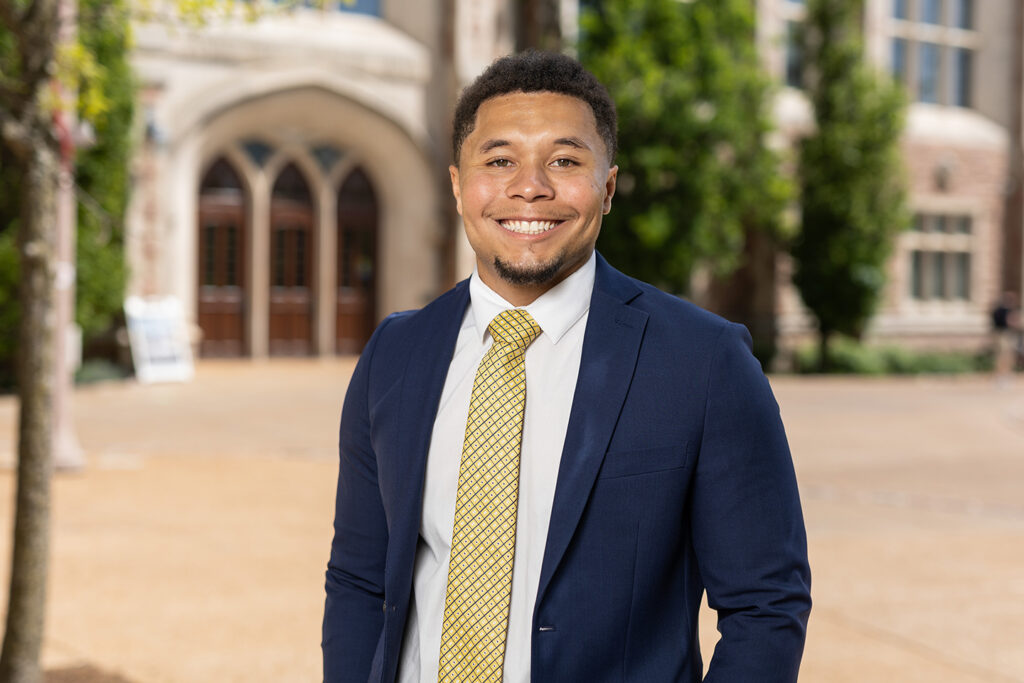
When Blake Comeaux arrived at WashU, he brought talent, drive, and an openness to possibility, but also quiet doubts about whether he truly belonged.
Coming from a Title I public high school in southern Mississippi to an elite academic environment was jarring. But what he found was a community of people who consistently reinforced that he wasn’t just welcome, but that he was exactly where he was meant to be.
That sense of affirmation began even before Comeaux officially set foot on campus. Selected as a McLeod Scholar as an incoming first-year student, he arrived already connected to a program centered on access, mentorship and achievement.
“Being designated as a McLeod Scholar imparted to me that the people at WashU deeply believed in me and what I could accomplish,” he said. “This feeling of support helped me immensely whenever I had self-doubts in the early part of my academic journey here.”
The McLeod Scholars Program, which honors the legacy of former Dean Jim McLeod, selects scholars based on their humility, intellectual curiosity and commitment to serving others, all qualities of the late dean.
Those values framed the way Comeaux experienced WashU from the beginning. Now approaching completion of his juris doctor, he reflects on a college experience shaped by multiple forces, but defined by the relationships he built.
Being designated as a McLeod Scholar imparted to me that the people at WashU deeply believed in me and what I could accomplish. This feeling of support helped me immensely whenever I had self-doubts in the early part of my academic journey here.
Blake Comeaux
Football coaches like Larry Kindbom and Scott Mueller helped establish an early foundation of support, and teammates offered a built‑in sense of community that helped him find his footing during the transition to campus life.
As Comeaux grew at WashU, so too did his network of support. Through the Ervin Scholars Program, he found overlapping academic and social communities that made campus feel more connected.
“The Ervins are extraordinarily involved on campus,” he said. “It was almost impossible to join an organization without finding one of them already active or serving in a leadership role. That presence made stepping into new spaces feel far less intimidating.”
That familiarity mattered most during moments of uncertainty. In his first philosophy class, for instance, Comeaux recalls feeling out of place, grappling with unfamiliar texts and wondering if he could keep up. Support from older Ervin Scholars, through mentorship and informal academic networks, helped ease those doubts.
The support systems that defined Comeaux’s early experience at WashU continued to deepen through individual relationships, including one particularly formative connection with Vice Chancellor for Student Success Dr. Anna Gonzalez. Though he can’t pinpoint the exact moment they met, Comeaux said Dr. G’s presence became a constant during his time at WashU as an administrator, mentor and trusted sounding board.

“She’s been an incredible mentor and a genuine friend,” he said. “Having someone with such a wide‑ranging career who’s willing to slow down, sit with you, and really talk has meant a great deal to me, and it’s always a joy to see her.”
That pattern of mentorship also opened doors beyond campus. During the summer between his sophomore and junior years, Comeaux was selected as a Goldman Fellow, now known as the St. Louis Fellows, through the Gephardt Institute, a program designed to connect students more deeply with the St. Louis community through civic engagement. Through that program, Comeaux worked at the U.S. Attorney’s Office for the Eastern District of Missouri, an experience that marked his first exposure to the legal field. Guided by program leaders like Stephanie Kurtzman, the experience paired professional work with intentional community engagement and leadership development. For Comeaux, it was another example of how WashU’s investment in mentorship translated into meaningful opportunity.
“When I think about my time at WashU, programs like the Goldman Fellowship stand out,” he said. “It was my first legal experience, my first time really discovering St. Louis, and one of many moments where the university trusted me with opportunities that shaped where I’m headed now.”
As he moved into law school, that pattern of close, meaningful mentorship continued to shape his path. In Professor Cash Nickerson, Comeaux found a trusted mentor who blended practical legal training with personal guidance.
“I don’t have lawyers in my family, so having someone like Professor Nickerson, who’s done so many different things and is always willing to talk things through, has meant a lot,” Comeaux said. “He’s helped make what felt like an overwhelming career path feel much more navigable.”
Now preparing for consecutive federal clerkships after graduation, Comeaux will first serve with Chief Judge Andrew P. Gordon on the U.S. District Court of Nevada in Las Vegas before clerking for Judge Salvador Mendoza, Jr. on the U.S. Court of Appeals for the Ninth Circuit, based in Richland, Wash. As he readies himself for that next chapter, Comeaux remains deeply connected to WashU.
My gratitude to the school is just immense. WashU supported me in every way, from scholarships and stipends to the suit I literally wore to my clerkship interview.
Blake Comeaux
“My gratitude to the school is just immense,” Comeaux said. “WashU supported me in every way, from scholarships and stipends to the suit I literally wore to my clerkship interview.”
For him, WashU isn’t just where he earned degrees. It’s where he found his people.
“This is quite possibly the most significant time of my life,” said Comeaux. “I recognize how profoundly my time here has shaped my future, and how much of it wouldn’t have been possible without the people who have been a part of my journey,” he said.
Engagement & Belonging is one of the Division of Student Success’ five anchors that deliver a transformative student experience. Student Success helps create a community where students feel at home and are empowered with the tools to grow, learn and flourish.